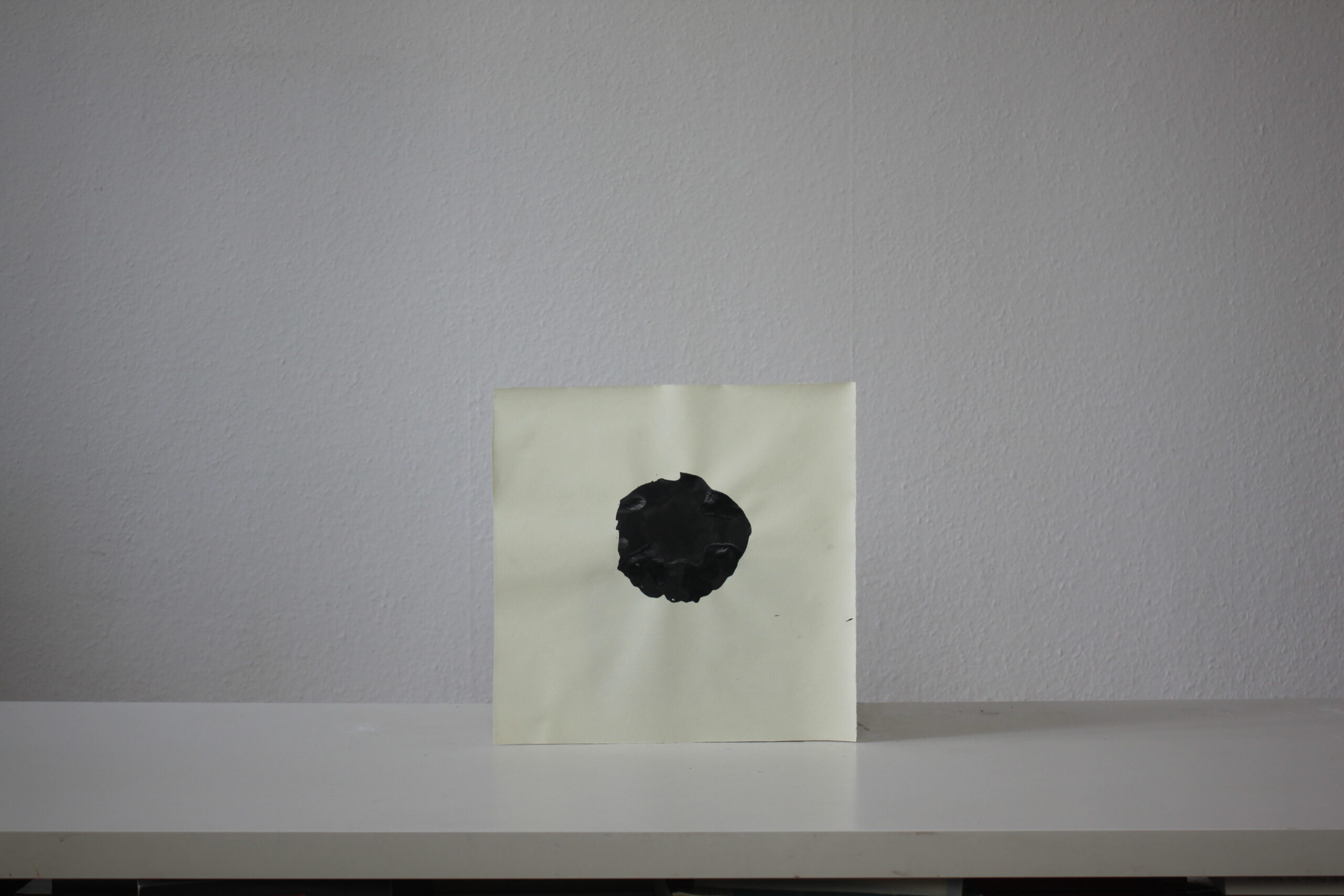
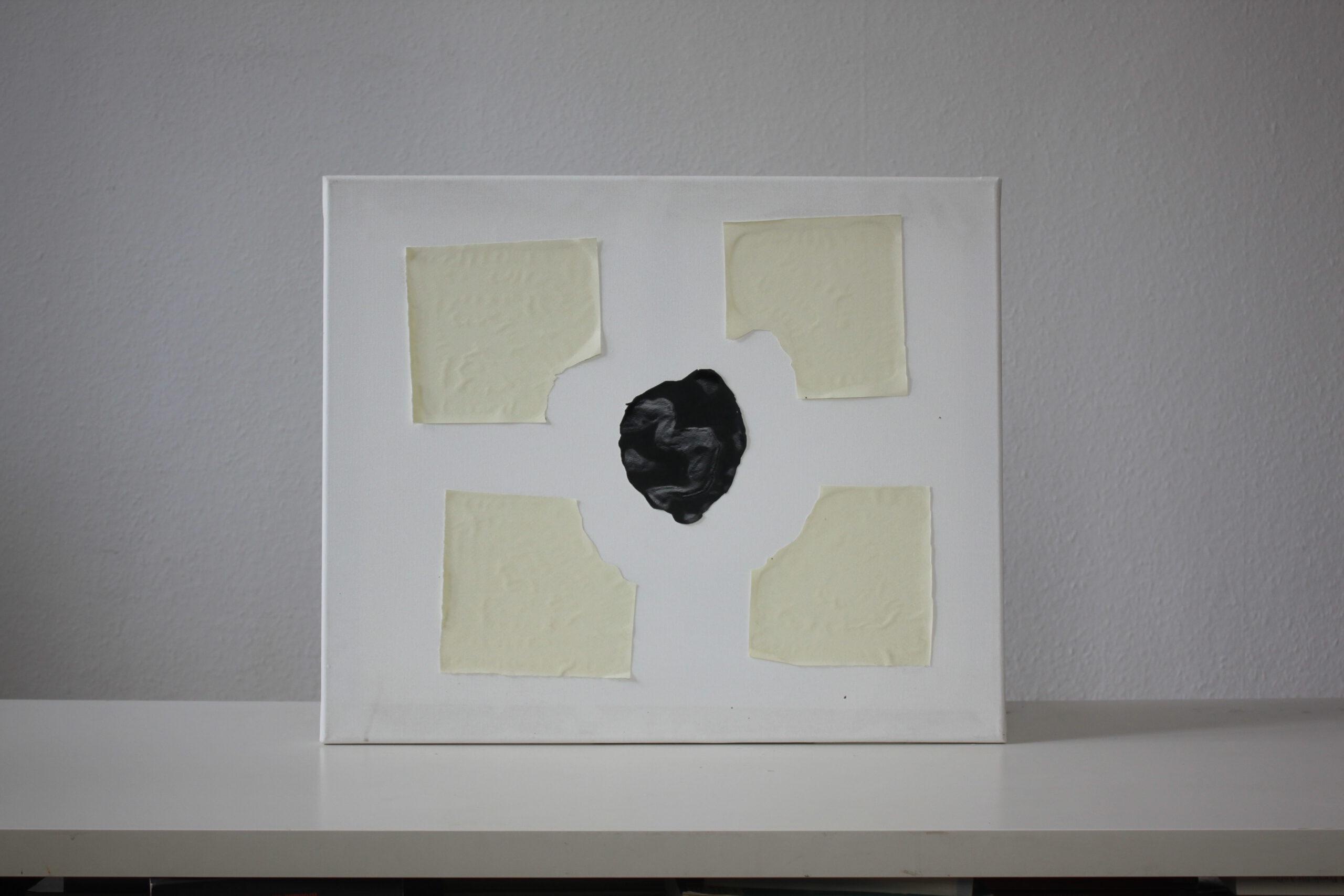
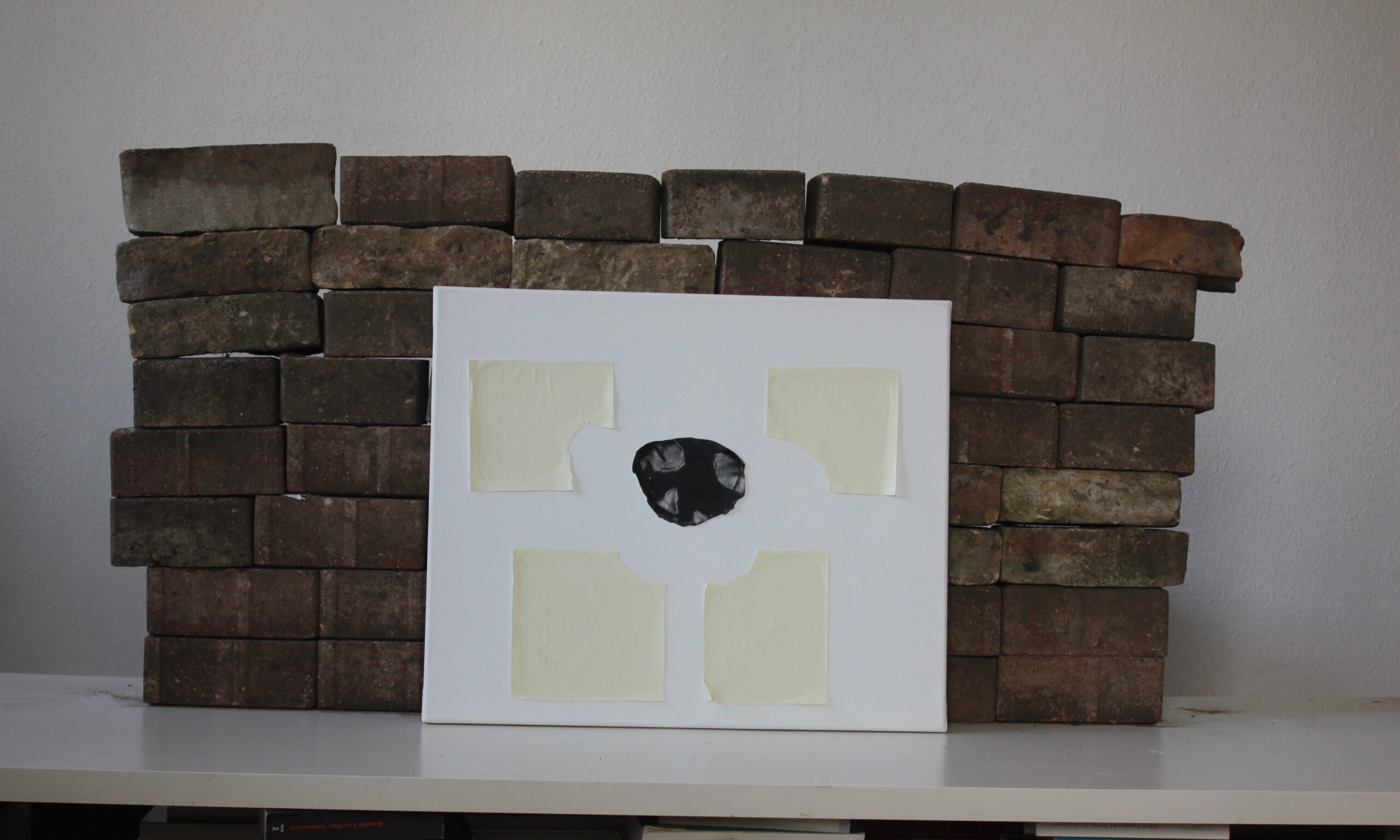
Study #3 is part of an experimental series of artworks that engage with metaphysical questions and aesthetic explorations of space and time. This work specifically focuses on objects and spaces, as well as the dimensionality of spaces.
The artwork consists of three parts: a blotting paper stained with black oil paint, a canvas on which a corresponding copy of the first piece is cut up and adhered, and a third part where a copy of the second piece is attached to a loosely assembled brick wall. The materials and construction are intentionally minimalistic, directing attention to the essential characteristics of objects within spaces. This approach is also a commonality with „Study #4.“
During the conceptual deliberations and the creation of the work, the artist perceived a kind of necessity. This necessity emerged through the conceptual planning, the choice of materials, and the execution of the piece. „Perhaps this necessity is deeply rooted in the artist’s perspective on the world and naturally connected to the world itself. Paradoxically, this apparent necessity creates a precondition for freedom, a freedom of creation and artistic expression.“
The character of the artwork is experimental in terms of style, artistic expression, and methodology. It aligns most closely with the concept of Environment. „Study #3“ was set up in the artist’s then-home in Hamburg to produce a photographic documentation. After the photoshoot, the installation was dismantled.
„[…] Anyone who can experience the bare wall is best prepared to experience a painterly work: the two-dimensional, impeccably smooth, vertical, proportioned, ’silent‘, sublime, self-asserting, inverted, limited from the outside and radiating outwards is an almost primary ‚element‘. And the primary element is the ‚A‘ of the art mind, after which the ‚B‘ must inevitably come: it must, as it can. […]“
„[…] Wer die kahle Wand erIeben kann, ist am besten zum Erleben eines malerischen Werkes vorbereitet: die zweidimensionale, tadellos glatte, vertikale, proportionierte, ’schweigende‘, erhabene, sich behauptende, in sich gekehrte, von außen begrenzte und nach außen ausstrahlende Wand ist ein fast primäres ‚Element‘. Und das primäre Element ist das ‚A‘ des Kunstverstandes, nach dem das ‚B‘ unvermeidlich kommen muß: es muß, da es kann. […]“
Wassily Kadinsky, Die Kahle Wand in: Der Kunstnarr, 1. Jahrgang, 1/1929, Dessau 1929, S. 20–22.