Kleine Parabel 浮生寓言
24 Years of Kafka and I
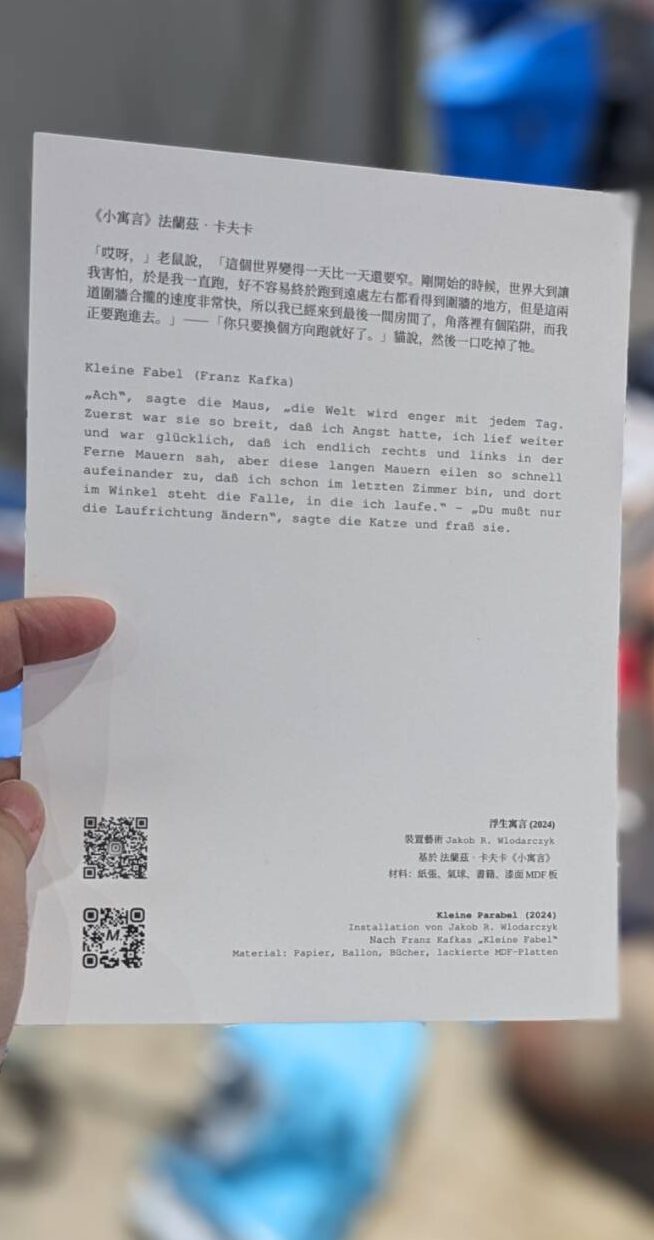
Kleine Parabel 浮生寓言, Installation / Mixed Media, 2024
The installation is based on Franz Kafka's parable "Little Fable" ("Kleine Fable"). Adapting Kafka's surreal world into a three-dimensional installation may present a unique challenge – but it is precisely this challenge that I deliberately sought. There were two central reasons for this.
The first is personal: I have known "Little Fable" for over 25 years. I grew up with it; it has accompanied me. Time and again, I take my old, yellowed school edition of Kafka's "Stories" from the shelf and leaf through it. I do this in phases, roughly every few years. It feels like visiting an old acquaintance – though the comparison falls short. It is more like a city trip with a fixed itinerary, except that the city is defined by surreal architecture and its own logic of time, where the unusual and the dreamlike unfold.
Perhaps it is this very surreal architectonics in Kafka's work that compelled me to approach the story through the means of visual art. Few writers grant spaces and structures such a central role. In Kafka's work, they seem not only connected to the inner logic of his narratives but actually shape it. Prime examples include "The Castle," but also "The Metamorphosis," which takes place almost entirely within an apartment. Even his shorter texts are permeated by spaces and architectures: "The Burrow," "The Great Wall of China," "The City Coat of Arms" – to name just a few.
Kafka's late work, the parable that Max Brod gave the somewhat diminishing title "Little Fable," was written at a time when Kafka's illness was already advancing. Yet, defiantly, he chose the form of a parable and cast a cat and a mouse as its protagonists – a seemingly childlike, naive, and innocent, yet universally resonant perspective. However, the choice of form stands in sharp contrast to the story's inherent theme: In just a few sentences, Kafka encapsulates an entire human life – tragic in content, light and innocent in form.
Although the brevity and clarity of Kafka's text might seem the most promising foundation for visualization, the task proved all the more difficult. The parable is so condensed, so complete in itself, that it leaves no room for adaptation or variation – any addition would dilute it, any omission mutilate it. The only way out of this artistic dead end was to change perspective: a shift that does not illustrate Kafka's text, but answers it – taking in both his surreal spatiality and temporality and the existential themes at hand, and adopting the only perspective available to me: my own. The result of this endeavor was presented in 2024 at the Free Art Fair in Taipei.